Engineering case study / TransmitFlow
A file transfer is a conversation between two browsers.
TransmitFlow turns that conversation into a simple flow: choose files, share a code, and receive. Underneath are connection setup, chunked data, and decisions about what happens when something goes wrong.
- Project
- Personal / open source
- Scope
- Interface & transfer system
- Stack
- Next.js · WebRTC · Socket.IO
- Status
- Deployed at transmitflow.fun
01 / The experience
A small interface with a lot of state behind it.
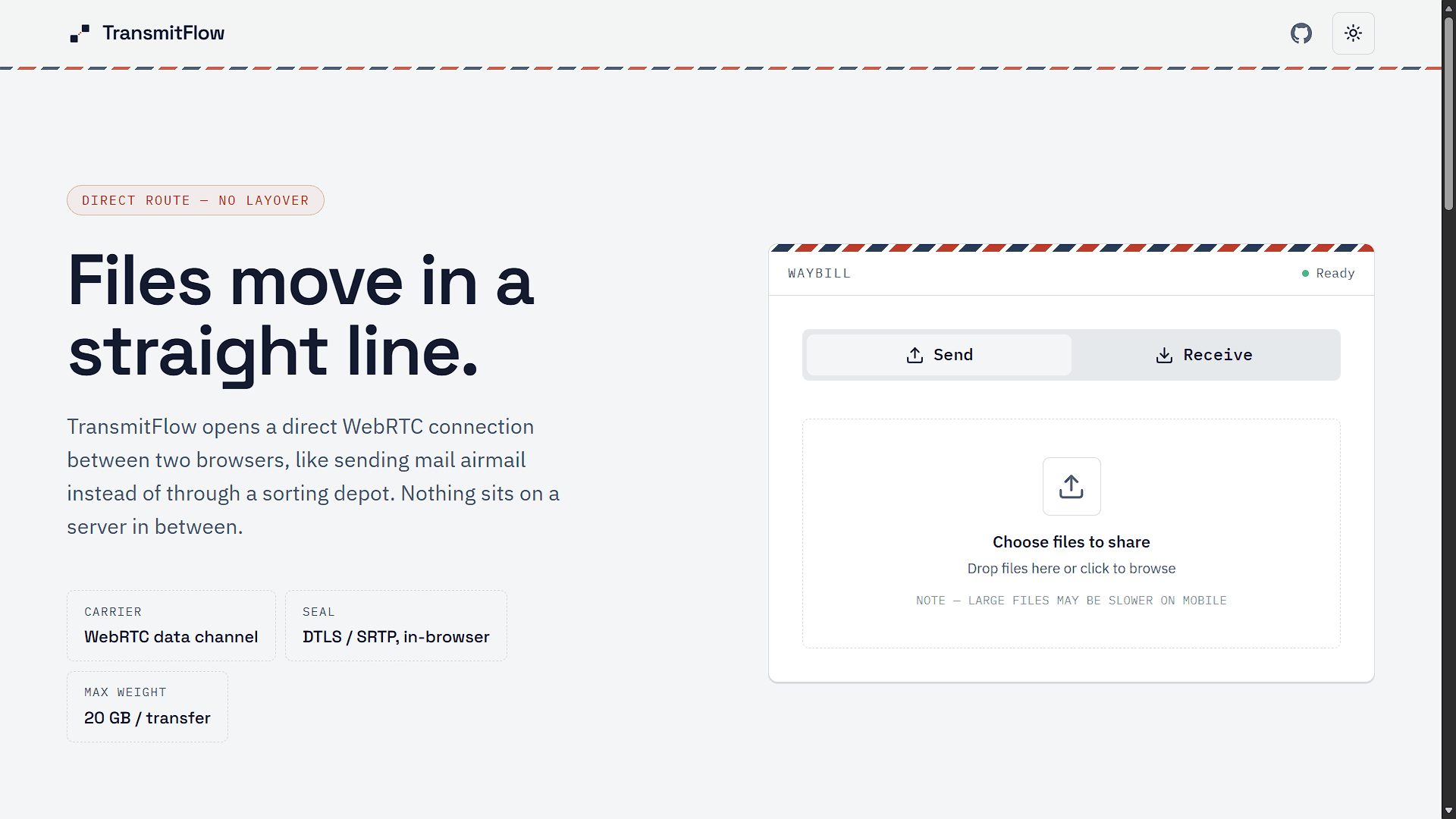
Moving a file to another device should not require creating an account or leaving a copy in cloud storage. TransmitFlow starts with two actions—Send and Receive—and pairs the browsers through a room code, share link, or QR code.
The interface has to distinguish waiting for a peer, establishing a connection, transferring, and finishing. A progress bar alone cannot explain all four. The transfer controller keeps those states together, while separate panels render the sender, receiver, and progress views.
This separation matters when an attempt fails: the interface can offer a specific recovery action instead of leaving the user with a spinner and a generic error.
02 / The system
Coordinate first. Transfer second.
A Socket.IO signaling server coordinates the room and exchanges connection information. File payloads travel over a WebRTC DataChannel. A direct connection is preferred; TURN can relay traffic when the network requires it and a relay is available.
Room coordination
- Sender
- Signaling server
- Receiver
Room membership, session descriptions, and ICE candidates.
File payload
- Sender
- WebRTC / TURN if needed
- Receiver
The signaling server does not store the transferred files.
On the receiving device, chunks can be persisted in IndexedDB to reduce memory pressure. The transfer flow tracks missing chunks and uses SHA-256 integrity checking before treating a file as complete.
UI and transfer architecture (opens in a new tab)03 / Tradeoffs
Keep the browser in control of the workload.
Chunking and backpressure
The documented transfer path uses smaller chunks on mobile and monitors the DataChannel buffer. Sending pauses while the buffer drains, rather than queuing the whole file as fast as the application can read it.
The tradeoff is more coordination in the sender in exchange for better control of memory and queued data.
Local chunk storage
IndexedDB gives received chunks a local storage path instead of keeping everything in an in-memory collection. Missing indices can be identified before assembly.
Browser storage limits, cleanup, and final file assembly still need care; local storage does not make memory unlimited.
04 / A recovery detail
Retry needs a clean start.
An expired room code cannot become useful just because the user presses Retry. The v0.2.0 changelog records a change to sender retries: create a fresh room code after a timeout or terminal failure, rather than reusing an expired one.
- 01
Failure
A timeout or disconnect ends the current attempt.
- 02
Reset
The sender creates a fresh room code.
- 03
Reconnect
The receiver joins the new attempt using the updated code or link.
The engineering lesson is small but useful: an error action needs to reset the underlying state, not only change what the screen says. Role-specific recovery actions and clearer transfer messages are part of the same release.
See the documented recovery changes (opens in a new tab)05 / Evidence & limits
Inspect the behavior, including the edges.
The repository includes integration tests for out-of-order chunks, duplicate detection, missing-chunk repair requests, cancellation, and resource limits. They use a simulated peer transport, which makes those conditions repeatable. Real browser and network testing remains a separate part of validation.
- Large files can still strain low-memory devices, even with chunking and local storage.
- Connection success depends on the network and the availability of signaling and relay services.
- The application avoids server-side file storage. That does not mean a server can never relay encrypted traffic.
- Cached interface assets do not remove the need to establish a connection between peers.
A useful next validation step is a documented device-and-network matrix, especially for larger files and interrupted transfers. This page makes no throughput or reliability guarantee.
Implementation references are pinned to repository revision 64bc244, reviewed 13 September 2026. The live interface may evolve independently.